Analytical Chemistry · Method Development · 2026*
Most HPLC methods are not optimized badly. They are optimized in the wrong order — one setting adjusted at a time, in whatever sequence the analyst happens to think of, until the chromatogram looks acceptable. The result is usually a method that works on one instrument, on one day, with one column lot.
The alternative is to work in order of leverage. Define what you are separating and what counts as success, then change selectivity before you touch the flow rate, and only then tune the mechanical variables. Done in sequence, the same effort produces a method that transfers and validates; done out of sequence, it produces weeks of rework.
## Step 1 — Define the separation problem before changing anything
Record the symptom precisely: co-elution, tailing, drifting retention, rising backpressure, weak response, or an excessive run time. Vague observations produce vague fixes.
Then identify the **critical pair** — the peak pair that matters to the release or research decision. Improving a minor impurity while sacrificing the critical pair is not an improvement, however much better the chromatogram looks overall.
Set measurable targets before you start: retention repeatability, peak-area precision, critical-pair resolution, tailing factor, plate count, and cycle time. Also record sample solvent, concentration, injection volume, column dimensions, additives, and detection wavelength, so that later changes in selectivity can be separated from variability that was in the preparation all along.
## Step 2 — Change selectivity first
Selectivity almost always has more leverage than a small flow-rate adjustment, yet it is usually the last thing tried. For reversed-phase work:
**Stationary phase.** Compare phases at controlled dimensions and particle size. C18 is a useful default, not a universal answer — basic, acidic, and highly polar analytes frequently need a different phase or an additive system.
**pH.** Control it with a defined buffer, and verify that the final pH is measured in the intended aqueous component. Small pH shifts change analyte ionization, and therefore retention and selectivity. Keep buffer concentration, preparation order, filtration, and storage consistent — otherwise pH becomes a moving variable you cannot diagnose.
**Solvent identity and proportion.** Screen these separately. Acetonitrile and methanol can show genuinely different selectivity at similar elution strength. Change one factor at a time, or use a small experimental design, then confirm the result with freshly prepared mobile phase. A stronger solvent shortens the run but compresses the critical pair.
If the method uses volatile additives, check detector compatibility and source cleanliness before comparing results between runs.
## Step 3 — Choose isocratic or gradient deliberately
**Isocratic** suits samples with a narrow retention window, and wherever transfer simplicity matters. Constant composition simplifies equilibration and troubleshooting — which is why routine methods should stay isocratic when it meets the critical-pair target.
**Gradient** helps when early peaks need weak conditions while late compounds create an unacceptably long tail, or when selectivity across a wide polarity range is poor. It adds dwell volume and re-equilibration variables to everything else.
For isocratic work, optimize organic percentage around the critical pair and verify adequate retention of the first peak. For a gradient, define starting composition, ramp, wash, and re-equilibration time explicitly. If instruments differ in dwell volume, match the time at the column inlet rather than copying the programmed table between systems — this single detail accounts for a large share of failed method transfers.
## Step 4 — Tune flow and pressure within a defined window
Flow rate affects efficiency, pressure, and run time simultaneously. Start near the column supplier's recommended range, then test a narrow low-to-high window while watching resolution and backpressure.
Lower flow can improve efficiency but lengthens the run; higher more info flow raises throughput while reducing efficiency and risking the pressure limit. Treat pressure as a hard operating constraint, not a performance target to be maximized.
Published instrument specifications — flow-rate range, flow accuracy and precision, maximum pressure, detector wavelength range — define an **instrument-side screening window**. They do not confirm that a specific column, mobile-phase viscosity, and temperature remain within safe limits. Record the pressure at the final method, after equilibration, with a clean system, so future drift can be diagnosed against a baseline rather than a memory.
## Step 5 — Match injection, detection, and temperature to the sample
**Injection.** Volume and solvent strength create fronting, peak splitting, and distorted early peaks. Keep the sample solvent no stronger than the initial mobile phase where practical, reduce injection volume for overloaded peaks, and confirm concentration against the detector's linear range.
One discipline prevents a common misdiagnosis: prepare replicate vials from the same solution **before** changing chromatographic conditions. Otherwise preparation variability masquerades as a separation problem, and you optimize the instrument to fix a pipetting error.
**Detection.** Set the wavelength from the analyte spectrum or a validated method, never from a generic default. Instrument-specified wavelength accuracy and precision are useful planning facts, but actual sensitivity depends on analyte absorptivity, concentration, flow-cell condition, and the noise of the complete method — not on the detector alone.
**Temperature.** A thermostated column compartment can stabilize viscosity and retention, but it is not a cure for poor selectivity. If temperature control is being specified, confirm the compartment's range, stability, calibration evidence, and compatibility with the chosen column and mobile phase before treating it as a resolved variable.
## Step 6 — Verify with system suitability and robustness
After conditions are selected, run replicate standard or system-suitability injections — and define the limits **before** reviewing the results. Track critical-pair resolution, retention repeatability, area precision, tailing, and plate count. Inject a blank for carryover, and a representative matrix preparation for interference.
Then test robustness around the set point: organic percentage, pH, flow, temperature, wavelength, and injection volume. Use realistic variation, and identify the variable that threatens the critical result first — that is the one to control most tightly in the written method.
Document the column lot, mobile-phase preparation, equilibration volume, system configuration, and processing rules. A method that cannot be reproduced from its own documentation is not finished.
## Optimization checks at a glance
| Variable | What to monitor | Decision it drives |
| ------------------------- | --------------------------------------------- | ----------------------------------------------------------------------------------- |
| Selectivity | Critical-pair resolution and retention | Change chemistry, pH, or solvent before forcing flow changes |
| Mode | Isocratic stability vs gradient range | Weigh transfer simplicity against cycle time for the whole sample range |
| Flow and pressure | Run time, efficiency, pressure trend | Stay inside the column and instrument operating window; never chase the limit |
| Injection | Peak shape, area precision, linearity | Adjust solvent strength and load rather than chromatographic conditions |
| Detection and temperature | Response, baseline noise, retention stability | Confirm wavelength from spectrum; treat temperature as a stabilizer, not a selector |
| Robustness | Suitability results after small changes | Document the variable most likely to break the method |
## The order is the method
Better separation rarely comes from changing one setting at random. Work in order of leverage — critical pair first, selectivity second, flow and pressure third, sample and detection fourth, robustness last — and the method you finish with is the one you can transfer, validate, and defend. A stable isocratic method on a well-controlled selectivity is usually worth more to a routine laboratory than an elegant gradient that only works on the development instrument.
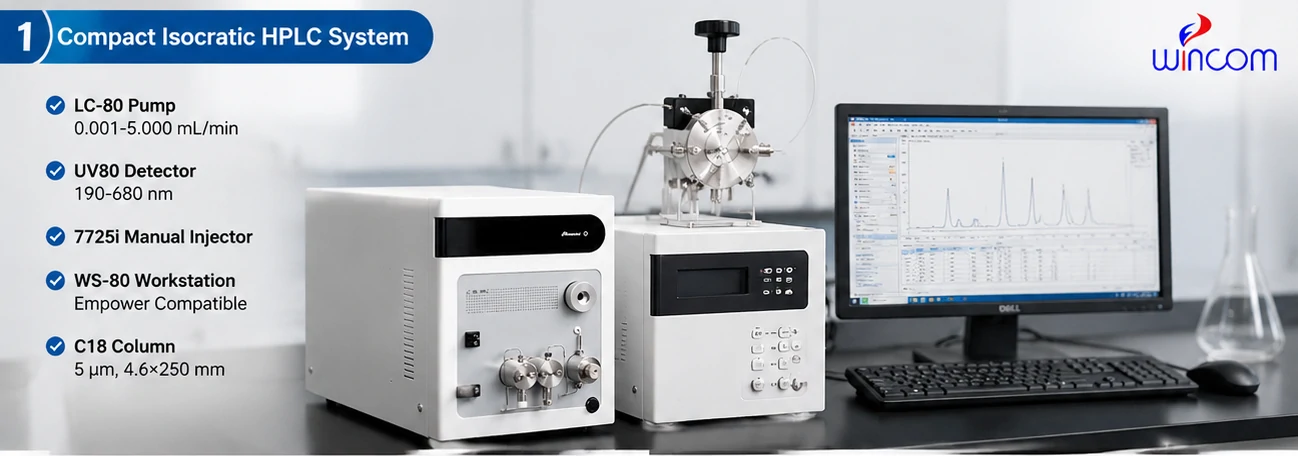
Laboratories specifying a system to support a defined method can start from the instrument side — for example by reviewing the published configuration of a [compact isocratic HPLC system](https://www.chinawincom.com/product/HPLC) against the required flow, pressure, and detection window — but the analyte, column chemistry, mobile-phase recipe, and target resolution still decide whether that configuration is an appropriate starting point.
## FAQ
**When should I switch from isocratic to gradient HPLC?**
Switch when a constant composition cannot retain early compounds adequately and elute late compounds in a reasonable cycle time, or when selectivity across the full sample range remains poor after solvent and pH screening. If transfer simplicity and routine robustness dominate, keep the isocratic method where it meets the critical-pair target.
**Can a UV detector be used below 200 nm?**
Many detectors specify a usable range that extends to around 190 nm, but a stated wavelength range is not evidence of adequate sensitivity. Confirm analyte response, mobile-phase absorbance, flow-cell condition, and baseline noise with a system-suitability test before treating a method as validated.
**Is the column supplied with a system suitable for every assay?**
No. A 5 µm, 4.6 × 250 mm C18 column is a defined starting configuration, not proof of universal analyte compatibility. Analyte polarity, pKa, matrix, target resolution, and restricted solvents all determine whether it is appropriate or whether another stationary phase should be used.
**How do I make a method transfer between instruments?**
Match the dwell volume and the time at the column inlet rather than copying the programmed gradient table, and re-run system suitability and robustness checks on the receiving instrument. Retention and resolution targets, not the settings, are what must transfer.
---
**About the author**
*This article was prepared with input from [Wincom Company Ltd.](https://www.chinawincom.com/), an exporter of laboratory instrumentation and equipment for laboratories, educational institutions, and distributors. Method-development questions are reviewed against the analyte, column chemistry, mobile-phase recipe, concentration, injection volume, and target resolution supplied with the enquiry — [send those details](https://www.chinawincom.com/contact-us) to confirm whether a given configuration is an appropriate starting point.